LEO is a multi-year physics project that demonstrates how Art can be the spark that connects Science, Technology, Engineering, Arts and Mathematics (STEAM).
Through creativity, complex ideas become tangible, engaging, and meaningful. LEO is a fitting name because our mascot is a lion and the constellation forms a question mark. It reminds us that every learning journey begins with a question. Each of the main stars in the constellation LEO represents a different layer of scientific understanding.
Art encourages us to move beyond simply finding the “right answer”. It creates space for imagination, experimentation, and curiosity, which are critical qualities that drive discovery in every field. In this way, art becomes a hub from which all other STEAM disciplines can grow and thrive.
The sculpture responds to the presence of people through motion sensors, creating a dynamic conversation between artwork and audience. As visitors approach, light and movement reveal the connection between human curiosity, technology, and the natural world.
LEO also serves as the Riverview Arts Center’s end-of-intermission signal, blending artistic expression with everyday function. By transforming discarded acrylic destined for the landfill into an interactive experience, the sculpture reminds us that creativity can uncover new possibilities in ideas, in learning, and in what we choose to value.
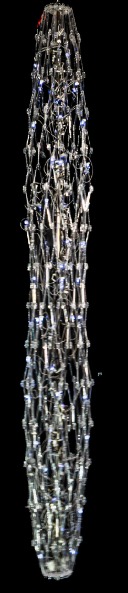
Alpha Leonis (2020-2021)
A study of the simplest forms of life.?
- Inspired by unicellular organisms such as bacteria, phytoplankton, and paramecium.
- Introduced students to laser cutting, electronics, coding, and engineering principles.
- Blueprints provided by Living Architecture Systems Group
- Represents the first step in the evolution of the larger LEO project.
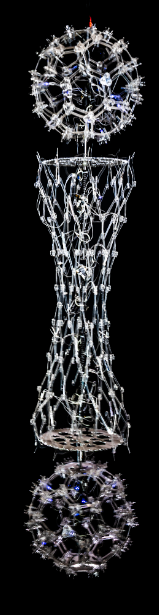
Gamma Leonis (2021-22)
A study in connection, attraction, and the forces that shape our universe.
- nspired by two atoms interacting through an electrostatic field, or two celestial bodies connected by a gravitational field.
- Teacher-designed and student-constructed.
- Marked a transition from assembling existing designs to creating original components.
- Investigated the physics of light through Snell’s Law and total internal reflection.
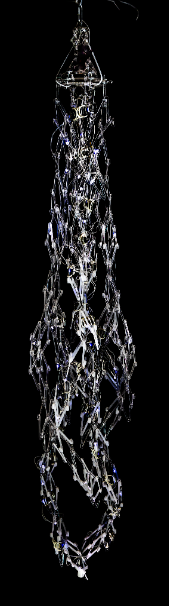
Eta Leonis (2021-22)
A study in hidden connections and the structures that bind the universe.?
- Inspired by String Theory, which explores the fundamental connections underlying matter and energy.
- Designed and assembled by an individual student
- Combined new and existing components to create structures that were both dynamic and stable.
- Demonstrated how artistic experimentation can lead to innovative engineering solutions.
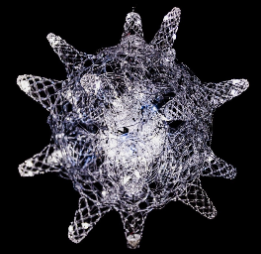
Mu Leonis (2022-24)?
A study in scale, from the microscopic world of viruses to the cosmic power of supernovae.?
- Student-designed and assembled.
- Features two concentric truncated icosahedrons, the geometry commonly found in a soccer ball.
- Built from laser-cut acrylic with antinodal line patterns that were heated and pulled into three-dimensional “Eiffel Tower” forms.
- Two years to bring original idea to life.
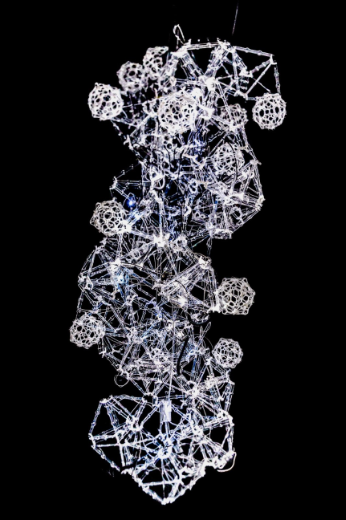
Zeta Leonis (2023-24)?
A study in biomolecules and the changing chemistry of addiction.?
- Inspired and constructed by two students.
- New acrylic skewers and 3D-printed connectors.
- Create tetrahedral carbon structures combining into a larger biomolecule.
- Dodecahedrons represent dopamine.
- Going up the sculpture, increasing concentrations of dopamine are required for an addiction sustained high.
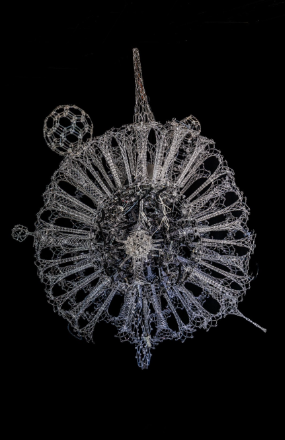
Epsilon Leonis (2022–2026)?
?A study in the structure and complexity of a living cell.
- Inspired by a phospholipid bilayer cell membrane.
- Teacher and student-inspired, student-built.
- Extracellular sugars, receptor proteins, and pores. The nucleus is represented by a truncated icosahedron with oil-filled vessels that create a lensing effect.
- The third iteration of Epsilon, demonstrating how ideas can grow.
Thank You